


How We Built a Custom Transportation Management System for USKO Logistics
How HebronSoft built Motion TMS — a custom cloud-based transportation management system connecting dispatch, drivers, accounting, safety, freight tracking, and logistics operations for USKO.

At a Glance
- Client — USKO Logistics · California, USA
- Industry — Transportation & Logistics
- Project length — 2.5 years
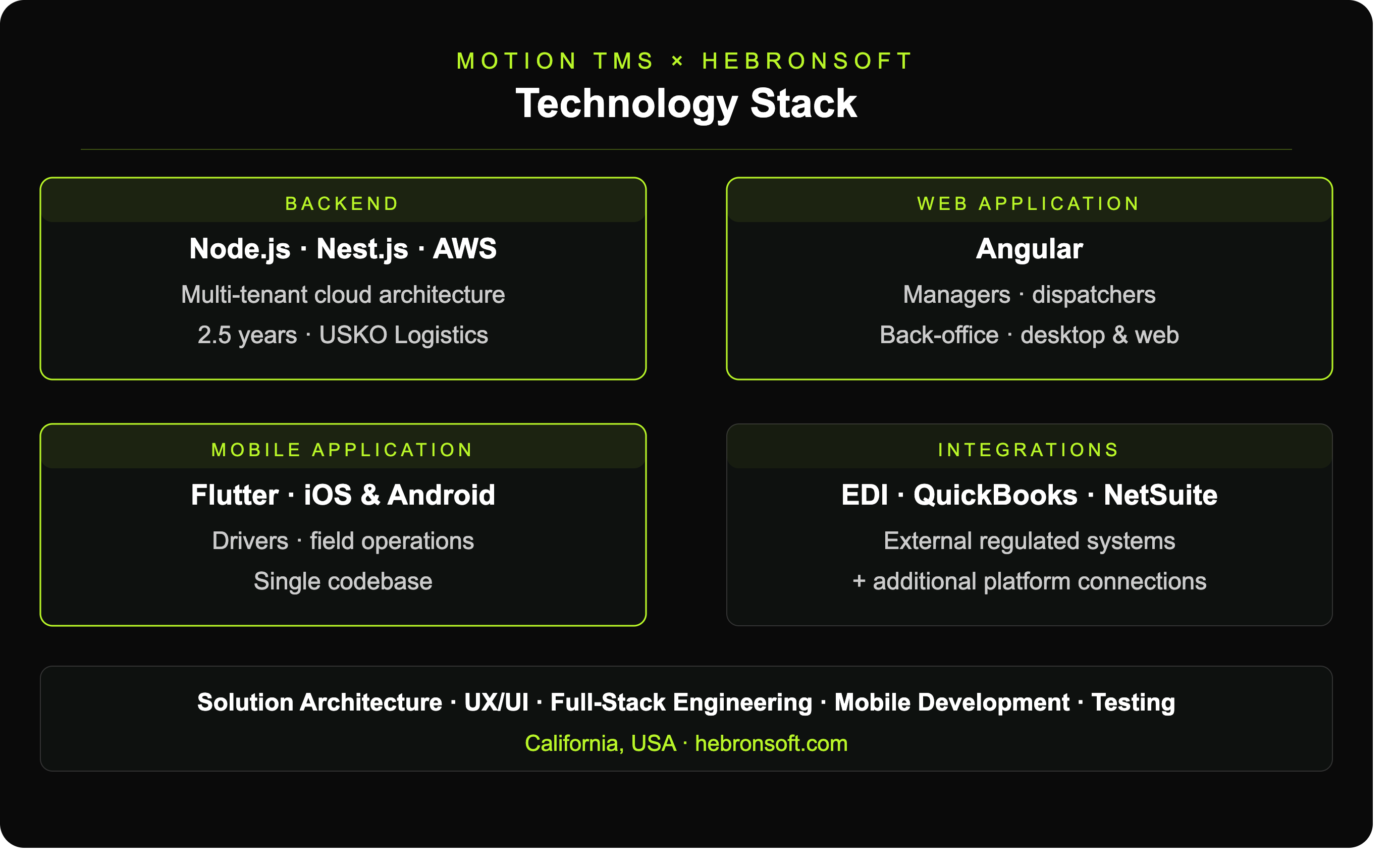
- Technologies — Node.js · Angular · Nest.js · Flutter · AWS
- Services — Solution Architecture · Product Planning · UX/UI · Full-Stack Engineering · Mobile Development · Integrations · Testing
- Integrations — EDI · QuickBooks · NetSuite
- Platforms — Web application (managers & dispatchers) · Mobile app (drivers)
USKO Logistics had already tried more than once to build its own transportation management system. The goal was ambitious: a custom TMS that could run USKO's own operations and eventually be licensed to other transportation companies. USKO knew logistics. The challenge was turning that operational knowledge into a scalable software product. HebronSoft joined the engagement with solution architecture, product planning, UX/UI, and engineering expertise — and built Motion TMS: a custom, cloud-based, multi-tenant transportation management system connecting dispatch, drivers, accounting, brokerage, safety, and fleet operations in one platform.
The Client
A logistics provider operating across land, sea, and air
USKO Inc. is a U.S.-based transportation and logistics company headquartered in West Sacramento, California. Founded in 2005 as a regional freight operation, the company has grown into a nationwide and global logistics provider spanning full truckload and LTL freight, refrigerated and specialized transport, warehousing, drayage, transloading, ocean freight, and air transportation.
Its operations extend beyond domestic logistics. As an FMC-licensed Non-Vessel Operating Common Carrier, USKO coordinates international ocean shipments, while its cross-border capabilities connect freight across the U.S., Canada, and Mexico. The company also serves government and defense customers through its USKO National SDVOSB joint venture.
What makes USKO particularly relevant to this story is its approach to technology. Rather than treating software as a supporting tool, the company has invested in building digital capabilities around its own operations — including Motion TMS, its proprietary transportation management system.
With multiple freight modes, different operational teams, international logistics, and increasingly complex data flows, USKO needed more than a generic transportation management system. It needed a system built around how the business actually worked — one it could own, evolve, and eventually offer beyond its own operations.
The Challenge
Siloed Departments and Disconnected Systems
USKO’s Accounting, Logistics, Finance, and Operations departments were working across disconnected platforms. Information needed to move between dispatchers, drivers, brokers, accountants, safety managers, and external systems — but the technology environment was fragmented and siloed.
Previous attempts to build a custom TMS had revealed a deeper problem: development alone was not enough. The project needed clear product architecture, structured requirements across multiple departments with very different workflows, and a design that could serve five distinct user groups without recreating existing silos inside new software.
The implementation phase added further complexity — multiple regulated external integrations including EDI, QuickBooks, NetSuite, and other platforms embedded in USKO’s operations.
Building the Product Before Building the Software
Custom TMS Architecture: Planning Before Development
HebronSoft brought together specialists in solution architecture, UX/UI, product planning, and engineering to define the system before moving into full-scale development. The team mapped how information moved through USKO — from loads and dispatch to drivers, documentation, settlements, safety, and accounting — and used that mapping as the foundation for Motion TMS.
This approach also shaped the economics of the project. Rather than starting from scratch, HebronSoft applied a pre-built TMS framework — a fundamental architecture with arranged modules and components ready for fast integration — and drove it with an experienced engineering team. The result was significantly faster time to market and a substantially lower budget than a ground-up build of the same scope.
What We Built
A Cloud-Based, Multi-Tenant TMS Connecting Five User Roles Across One Platform
Dispatch and Load Management
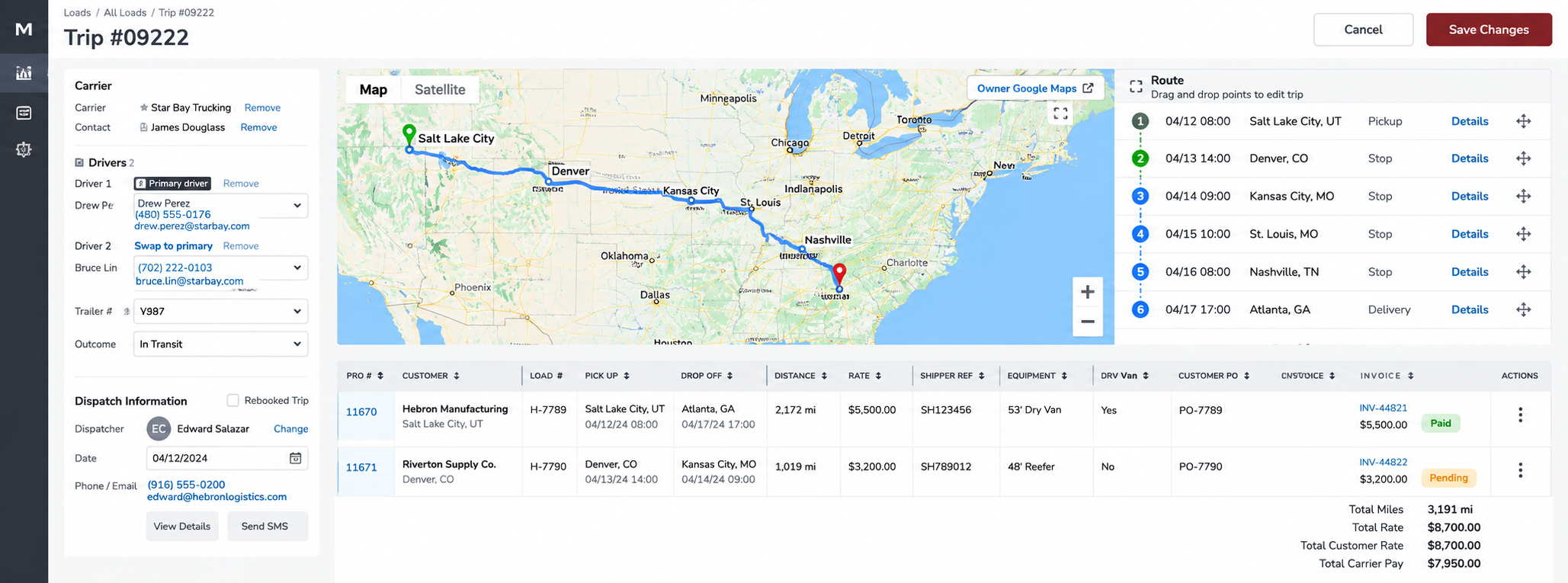
Dispatch sits at the center of transportation operations. Motion TMS gave dispatchers a dedicated interface to manage multiple loads, interact with other users across the platform, track freight, and monitor operational expenses — replacing the need for disconnected tools and giving dispatchers a single operational view.
Driver Mobile App for Fleet Management
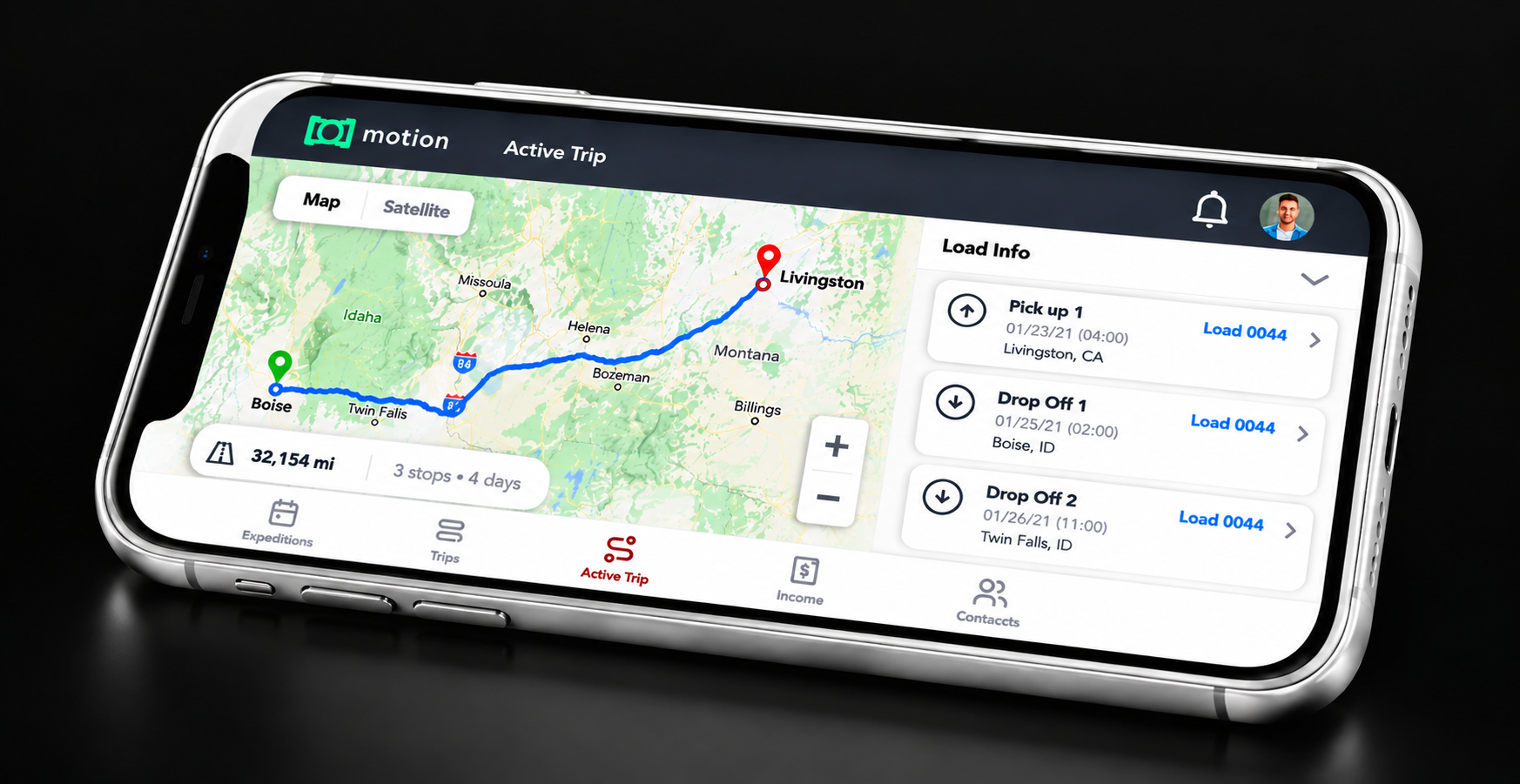
HebronSoft developed a mobile application that connected drivers directly with the TMS, bringing road activity into the same environment as dispatch and back-office operations. Drivers could access load details, communicate with dispatchers, receive advances for fuel and food expenses, and upload service receipts and financial documentation from the app.
Accounting and Settlements
Accounting was brought into the same platform. Accountants could manage invoices, create settlements, manage settlement accounts, and handle payments — breaking down the separation between transportation operations and the financial processes behind them.
Freight Brokerage and Carrier Management
Brokers could send rate confirmations to carriers, check carrier reliability, and track freight location from within Motion TMS — without switching between external systems for each task.
Safety Management and Compliance Alerts
Motion TMS included event-triggered alerts for time-sensitive compliance events: driver’s license expiration, vehicle inspection expiration, mileage limits, and fuel consumption limits. Safety managers could monitor these from within the platform rather than tracking them through separate processes.
TMS Integrations: EDI, QuickBooks, NetSuite
The platform was connected to external systems already embedded in USKO’s operations — EDI, QuickBooks, NetSuite, and other platforms. For a custom TMS, this integration layer is foundational: transportation software sits between operational, financial, carrier, driver, and customer data, and connecting those systems correctly is what turns individual features into a working platform.
From Siloed Departments to One Transportation Platform
The most significant outcome of this custom TMS development project was not any single feature. It was that USKO’s Accounting, Logistics, Finance, Operations, and field teams were no longer working in disconnected environments. Motion TMS — as a cloud-based transportation management system — connected each department’s workflows around the same transportation data: the same loads, the same freight, the same drivers, the same settlements — without forcing any user group to work inside a system built for someone else.
Off-the-shelf TMS software versus custom TMS development
Motion TMS Today
Motion TMS continued to evolve after the original HebronSoft engagement. USKO now describes Motion as its in-house transportation management system — the platform became part of the company’s ongoing technology infrastructure. In 2025, USKO announced a Motion TMS Driver App supporting real-time load information, documentation, driver and equipment management, safety compliance, and income information.
Those newer capabilities extend beyond the scope of the original HebronSoft project. But the continued development of Motion is a meaningful part of the story: the original engagement established a software foundation that USKO chose to keep building on.
Off-the-shelf TMS software versus custom TMS development
Why Build a Custom Transportation Management System?
Off-the-shelf TMS software can work well when a transportation company is willing to operate within the workflows the product already provides. USKO’s ambition was different. The company wanted software built around its own logistics processes — with ownership over the product, flexibility to customize, and the ability to continue developing it as operations evolved.
There was also a larger product vision: Motion TMS was intended not only for USKO’s internal operations but as a platform that could eventually be licensed to other transportation companies. That changed the question from “which transportation management system should USKO use?” to “how do we turn USKO’s logistics operations into a software product?”
Custom TMS development gives transportation companies:
- Ownership and IP rights over the software product
- Flexibility to customize workflows, integrations, and user roles
- Control over the roadmap and development priorities
- A path to SaaS or licensing — turning internal tools into commercial products
- Data-driven operations built around how the business actually works
What We Learned
What Custom TMS Development Actually Requires
Building custom transportation management software is not primarily about putting dispatch, tracking, accounting, and fleet management features onto one screen. The harder problem is understanding how a transportation company actually works. Drivers, dispatchers, brokers, accountants, and safety teams may all interact with the same load, but each sees a different part of its lifecycle. The software has to connect those perspectives without making the system harder to use for any one group.
For USKO, that meant turning years of logistics experience into a clear product and software architecture. For HebronSoft, Motion TMS demonstrated what custom TMS development should accomplish: not digitizing individual processes, but connecting the business behind them.

Their ability to change rapidly and advise us on what could be done differently distinguishes them.
"Their ability to change rapidly and advise us with things that could be changed or done differently distinguishes them. They provide their expertise and give different perspectives on our visions with additional feedback, which is great."


You might be interested in
How We Built the Financial Decisioning Layer Behind a Leading North American Vehicle Marketplace
How HebronSoft engineered the decisioning, integrations, and deal-math systems that turn thousands of vehicles and 40+ lenders into real, financeable offers in under 60 seconds.

Halo: When Help Can’t Wait, the Drone Arrives First — Inside the Platform That Makes It Possible
A drone-assisted safety platform that turns a single emergency request into real-time drone dispatch, operator routing, live tracking, and secure multi-tenant coordination for campuses and controlled environments.

Easy Scooters: Building the Digital Infrastructure for Lviv’s First Electric Scooter Sharing Service
This project started in 2018 — before AI-assisted development tools existed, before Flutter was a mature framework, and before electric scooter sharing had proven itself as a viable urban mobility model in Eastern Europe. Easy was among the first to bet on the idea in Lviv, and HebronSoft built the entire digital side of the business from the ground up.

 AI Assistant